Using planned maintenance
How the chief engineer completes a job and how the superintendent postpones one that is not a class item.
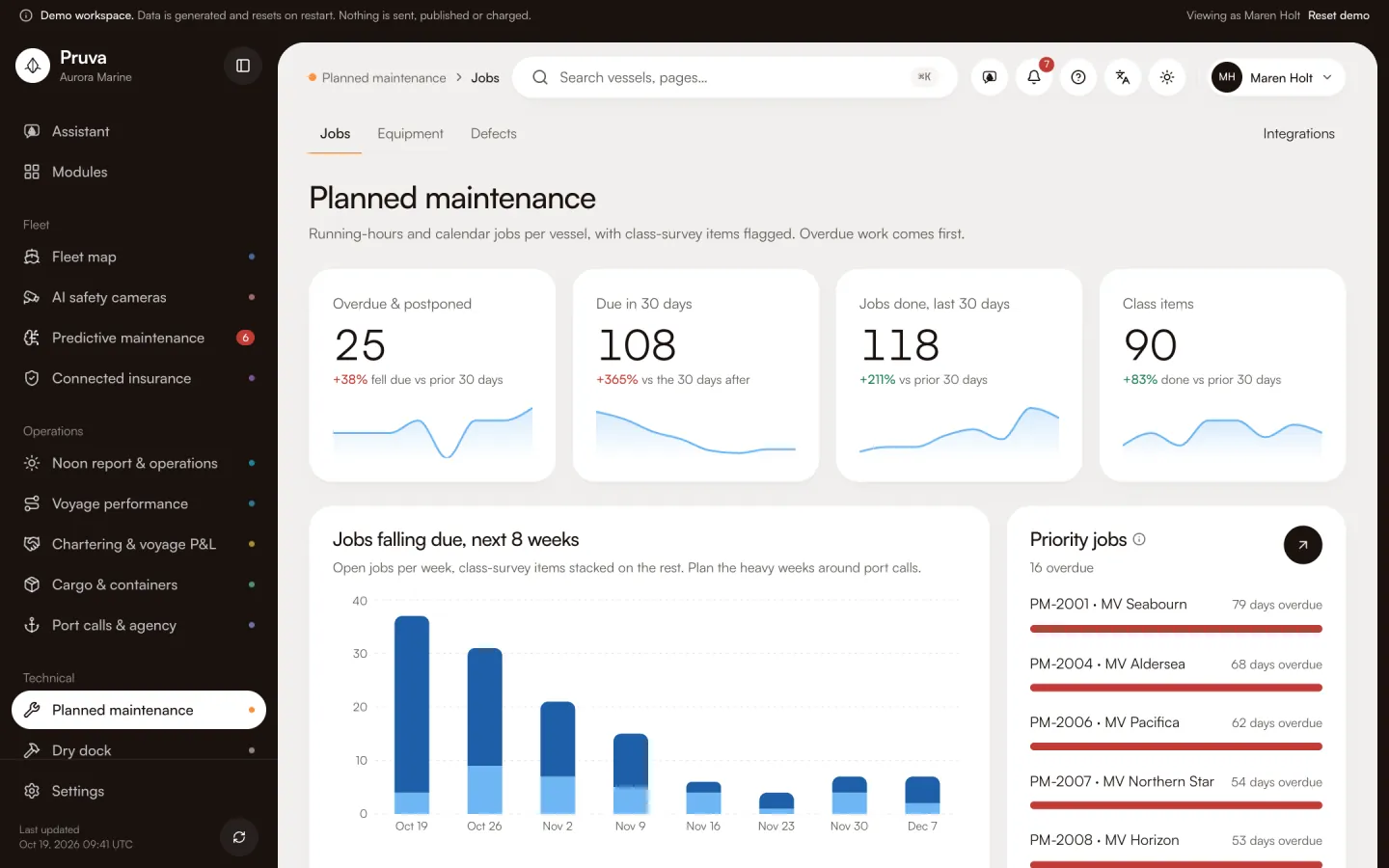
Planned maintenance is the equipment tree and the jobs that fall due on hours or on the calendar. The chief engineer on board completes the job and closes the defect. The superintendent ashore postpones a job that is not a class survey item, and only with a reason. The dry dock later collects the class jobs into a specification. This module keeps the job card.
Dashboard and pages
Jobs is http://localhost:4400/app/pms . Switch between the table and the board. The board lanes are overdue, due soon, later, postponed and done. Dragging a card to Done completes it. Dragging it to Postponed does not. The page tells you to use Postpone.
Equipment is http://localhost:4400/app/pms/equipment , the tree with maker, running hours and which items are critical. Defects is http://localhost:4400/app/pms/defects , open and closed, with equipment, severity, who reported it and when.
The job card is http://localhost:4400/app/pms/jobs/ and then the id. It shows the equipment, a running-hours counter, the class tag, the steps, the last sign-off, the defect, one spare request and the survey window. Integrations is http://localhost:4400/app/integrations/pms .
Workflows
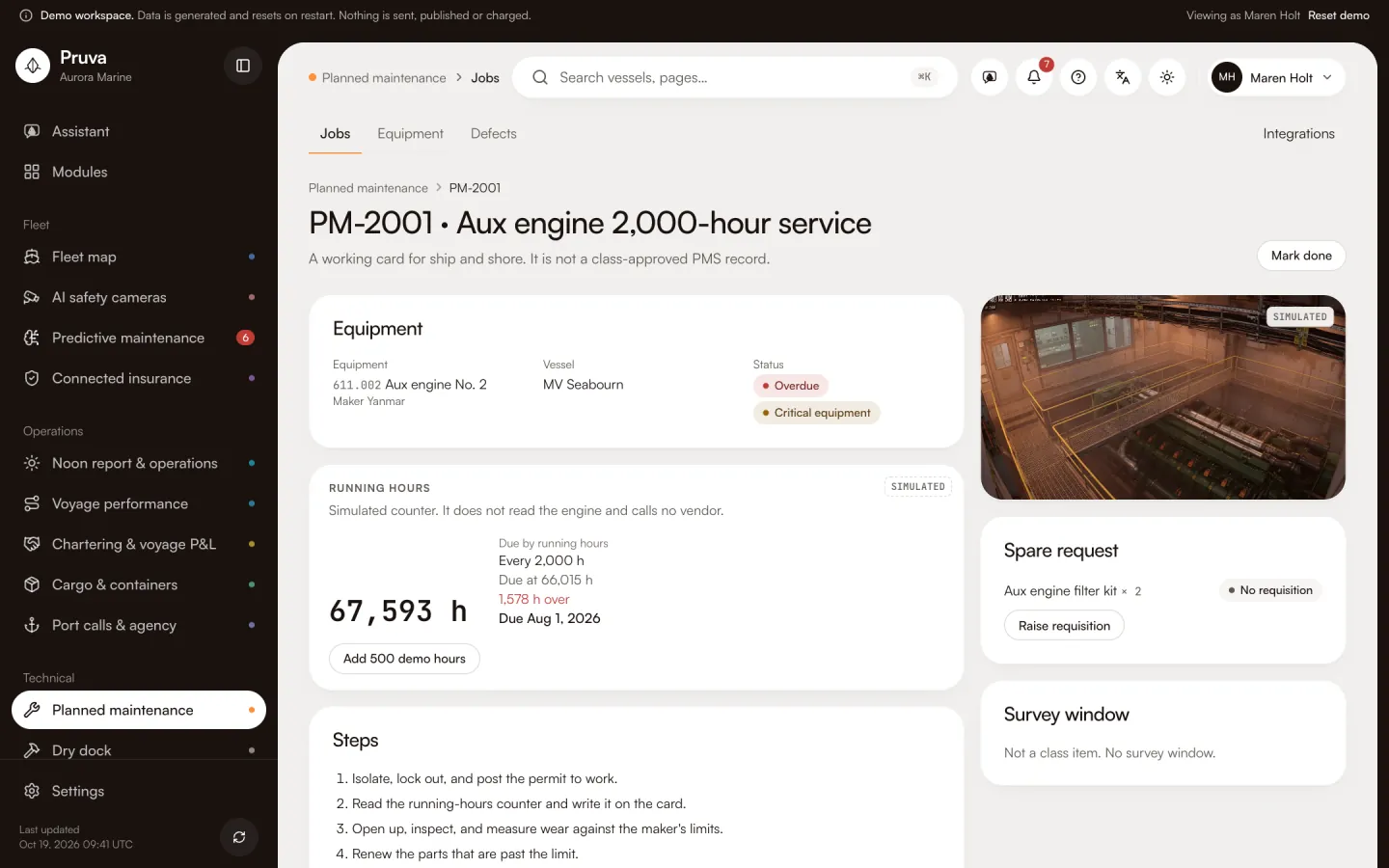
Mark done needs edit (pms.complete). The button is Mark done. Closing a defect needs edit (defect.close). Setting running hours needs edit (pms.hours). The action accepts 1 to 5,000 hours.
Postpone needs publish (pms.postpone). The list button is Postpone and asks for 14 days. The action itself allows 1 to 60 days and a reason of at least 5 characters. Class survey items cannot be postponed. In the demo Ravi Menon has edit, so he can complete a job and cannot postpone it. Kaan Erdem and Maren Holt have publish.
Shared records
The job card is the class or survey job. Documents show the survey window. Dry dock lists the same jobs without prices. Completing a dry-dock line that points at a job is Mark done on this card. The spare request reads the procurement requisition. It is not a second stock screen. Inventory owns the part. The running-hours counter is the equipment counter the alerts also read. In the demo that counter is simulated.
What the demo simulates
The job-card counter runs only in the demo. Database mode has no camera still on the card. The spare line is the real requisition in both modes. A dry-dock list with prices is not on this page. It is the dry-dock module.
Integrations
The Siemens historian, the MQTT gateway and DNV Veracity are mocks. See Connections and the module reference.