Using HSEQ and risk
How the ship reports an incident and how the shore closes it, approves a risk and signs a change.
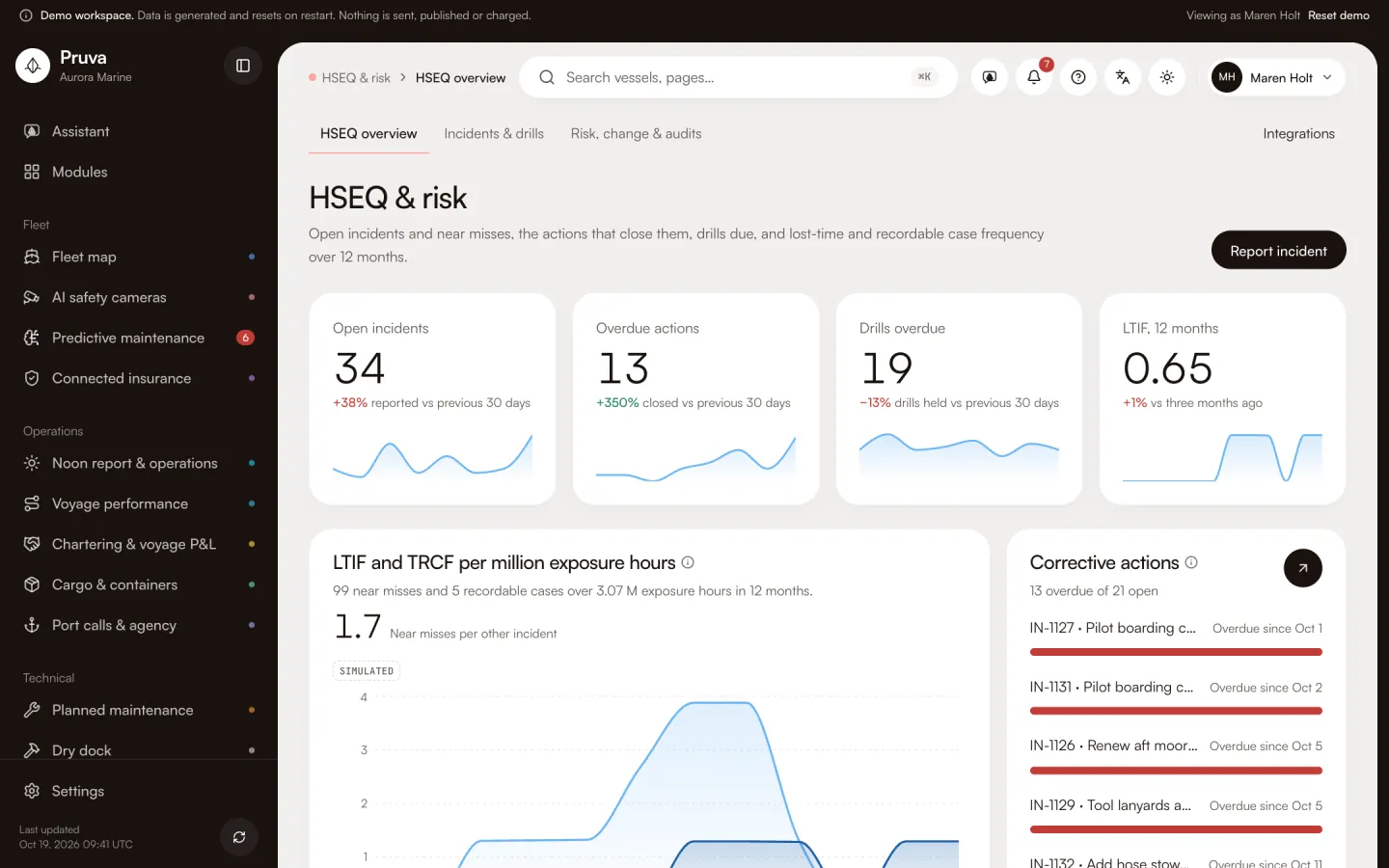
HSEQ is the record of incidents, near misses, drills, risk assessments, management of change and audits. The master and the chief engineer report what happened and add corrective actions. The designated person ashore, with publish, closes the incident, signs it, approves the risk assessment and approves the change. In the demo Ravi Menon and Capt. Erdem Yılmaz have edit. Kaan Erdem and Maren Holt have publish. Watchkeeper has edit and cannot close or sign.
Dashboard and pages
The overview is http://localhost:4400/app/hseq . It shows open incidents, overdue corrective actions, drills due and overdue, LTIF and TRCF per million exposure hours with a 12-month trend, the near-miss ratio, and camera events waiting for an incident.
Incidents and drills is http://localhost:4400/app/hseq/incidents . One incident is that path plus the id: the people, the timeline, the root cause, the actions, a linked camera still and the sign-off. The drills tab lists each drill with its due date, attendance and who signed it.
Risk, change and audits is http://localhost:4400/app/hseq/risk . Risk assessments show hazards on a 5 by 5 matrix, initial and residual risk, controls and approval. Change requests run from request to review. Audits (internal, external, flag, class, ISPS) show findings, due dates and close-out evidence. Integrations is http://localhost:4400/app/integrations/hseq .
Workflows
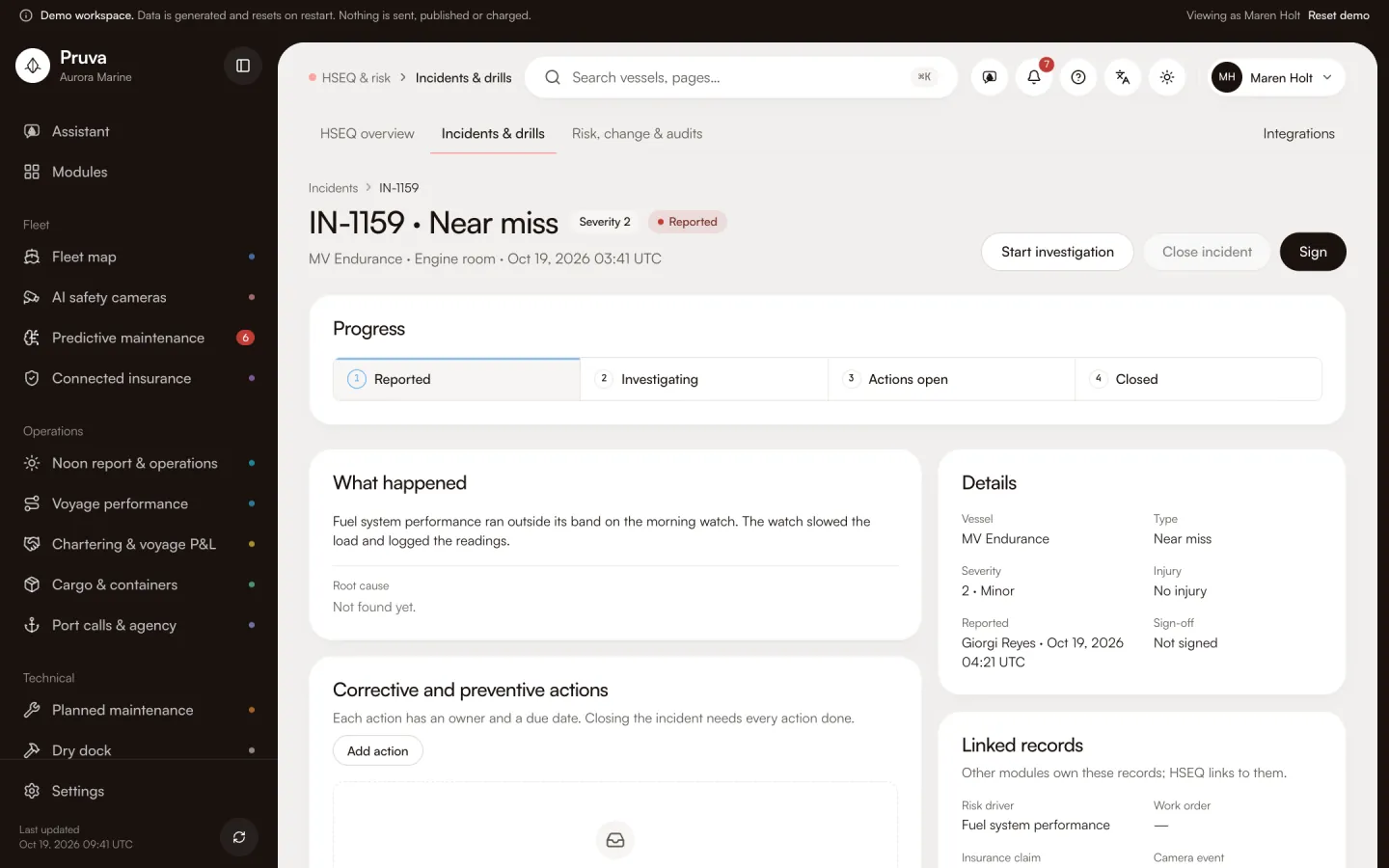
These need edit: report an incident (hseq.incident.report), investigate (hseq.incident.investigate), add an action (hseq.incident.add_action), close an action (hseq.incident.close_action), record a drill (hseq.drill.record), create a risk assessment (hseq.risk.create), request a change (hseq.moc.request), implement a change (hseq.moc.implement) and add an audit finding (hseq.audit.add_finding).
These need publish. Close incident (hseq.incident.close) is refused while an action is open, and actions are refused on a closed incident. Sign-off (hseq.incident.sign) records who signed. Approve on a risk assessment (hseq.risk.approve) accepts it. Approve or reject a change (hseq.moc.approve) records the decision. A risk assessment can be linked only when the decision is approved. Review (hseq.moc.review) closes the review after implementation. Close a finding (hseq.audit.close_finding) needs the evidence text.
People named on an incident or a drill must be on that vessel’s crew list. The database refuses anyone else. A future incident date is refused. Without crew access the drill form shows no names and can still record the drill with no attendees.
Shared records
A camera event escalated to an incident stays pending until this module opens the incident. Reporting from that event writes the camera id back only when the person also has cameras edit. The vessel page’s incident is this signed record, not the old predictive-maintenance story. A claim is linked by code only. The insurance claim page is not filtered to it.
What the demo simulates
Incidents, drills, assessments, changes, audits and the exposure hours are generated. LTIF, TRCF and the near-miss ratio are computed from that exposure (crew on board times 24 times days). Aldersea has an overdue enclosed-space drill and open internal-audit findings. The oil-mist camera event is not yet an incident. Escalating it only marks the event. Connectors import nothing.
Integrations
The incident mailbox and the class QHSE portal are mocks. See Connections and the module reference.